February / March (usually visible from southern latitudes)
Notes
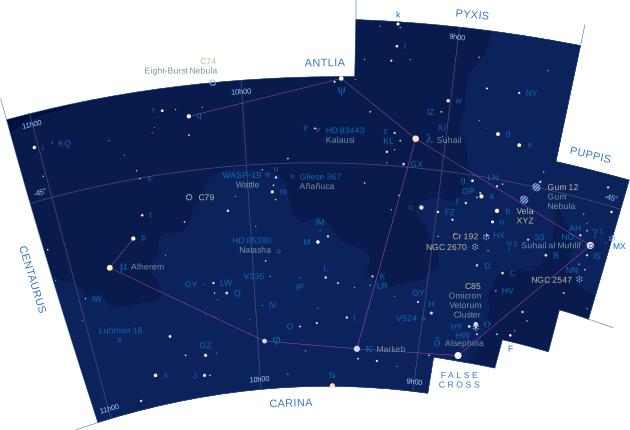
Vela can be located in the sky by following the band of the Milky Way southeastward through Puppis from Sirius in Canis Major, or northwestward from the distinctive cross shape of Crux.
Originally part of the 'superconstellation' of Argo Navis, which was divided into three for practical purposes. Vela forms the northeastern part of Argo, with Puppis lying to the west and Carina to the south. This subdivision has had the unusual consequence of leaving Vela
without an Alpha or Beta star on the Bayer system.
In the southern parts of Vela, a small asterism straddles its border with Carina. Two of Vela's stars, Alsephina and Markeb, combine with two in Carina to create the approximate shape of a cross. This shape forms a slightly fainter mirror of the more famous Southern Cross some distance to the east, and is known as the False Cross.
Vela is dense with stars across its entire area, but the main body of the Sail is formed from a quadrangle of four second-magnitudestars in the western segment of the constellation. The brightest of these is the westernmost, Suhail al Muhlif, with the red-orange Suhail falling to the north, and the pair of Alsephina and Markeb forming the Sail's southen edge.
Centred on a point in the west of the constellation is the Gum Nebula or Gum 12. This is a faint and roughly ring-shaped patch of nebulosity, indistinct against the background of the Milky Way, but covering a wide area of the sky. The nebula is the expanding remnant of a supernova that erupted some 11,000 years ago. At its heart, the exploding star that created the nebula can still be detected as the Vela Pulsar, PSR B0833-45, an object spinning so rapidly that it flashes with beams of light and radio waves more than eleven times each second.



 Show on Sky Map