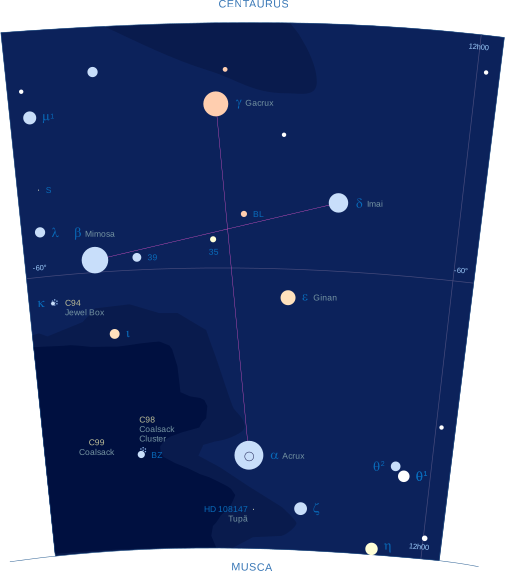
Tiny Crux carves out a thin sliver of space within the plane of the Milky Way.
Derivation:
All constellations are in some sense artificial, but while many, especially in the northern sky, date back thousands of years and have rich histories, the elegant Southern Cross has a rather prosaic derivation. In the late seventeenth century, Royer (or, according to some sources, Abbé de la Caille) simply carved a rectangular region of sky out of Centaurus and renamed it Crux (Latin for 'Cross').
Crux is often called the Southern Cross (Crux Australis) to distinguish it from the 'Northern Cross', a traditional, but entirely unofficial, name for the brightstars that make up the main structure of Cygnus in the northern sky.
With an area of less than seventy square degrees, Crux has the distinction of being the smallest constellation in the sky. It occupies only about one twentieth of the area of Hydra, the largest of the constellations.
Crux lies within a densely populated area of the Milky Way, and so in a densely starred region. As one might imagine from its name, the body of the Cross is made up of four brightstars, Alpha, Beta, Gamma and Delta Crucis. These stars are also known by the proper names of Acrux, Mimosa (or Becrux), Gacrux and Imai, respectively.




 Show on Sky Map