| Proper Name | Ixion | | Minor Planet Designation | 28978 Ixion | | Provisional Designation | 2001 KX76 | | Orbital Period | 248 years
90,604 days | | Distance from the Sun | Semi-Major Axis: 5,886,147,000 km (39.35 AU)
Perihelion: 4,452,512,000 km (29.76 AU)
Aphelion: 7,319,783,000 km (48.93 AU)
| | Eccentricity | 0.2436 | | Rotation Period | 12 hours, 24 minutes | | Diameter | 696.8 km (mean), 726.8 km (equatorial) | | Mean Surface Temperature | 64 K (-209°C) | | Moons | None known | | Parent star | The Sun, yellow dwarf | | Other planets in this system | Mercury, terrestrial planet
Venus, terrestrial planet
Earth, terrestrial planet
Mars, terrestrial planet
Jupiter, gas giant
Saturn, gas giant
Uranus, ice giant
Neptune, ice giant
Numerous dwarf planets, asteroids and other bodies
|
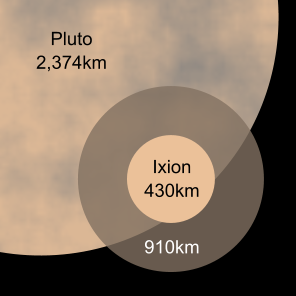
The diameter of Ixion is not known with certainty. This diagram shows its likely maximum and minimum values, shown against the dwarf planet Pluto for comparison.
A planetoid of the Kuiper Belt in the outer Solar System, Ixion belongs to the class of bodies known as plutinos, sharing important characteristics with Pluto. Like Pluto, Ixion follows an inclined and eccentric orbit and, also like Pluto, its orbit is in resonance with that of the ice giant Neptune. For every three orbits of the Sun that Neptune completes, Ixion and its fellow plutinos complete two, in a period of a little under 250 years.
By convention, bodies of the outer Solar System are named for mythological beings associated with the underworld. Ixion is named for a prisoner of Hades in Greek mythology, who was punished by being fastened to a fiery spinning wheel for eternity.
The structure and size of Ixion are not certain, and hence it is only provisionally classified as a dwarf planet at present. In form it is a slightly flattened spheroid shape, with its equatorial diametere measuring some 725.8 kilometres (and averaging roughly a quarter the diameter of Pluto). Water ice can be detected on its surface, as well as reddish tholins, chemicals created by the breakdown of organic compounds like methane that are commonly found on bodies whose orbit carries them far from the Sun.
|
|