The first item in Messier's catalogue is a supernova remnant in Taurus, an expanding cloud of matter surrounding the Crab Pulsar, the active remnant of the original star whose supernova explosion created the nebula.
In the constellation of Taurus, a star is exploding. The explosion began with a supernova almost a thousand years ago, and the resulting nebula, the Crab Nebula, is continuing to expand at more than 1,000 km per second. It is home to a powerful pulsar.
The shattered remains of an exploded star, the Crab Nebula is the result of a supernova that occurred more than six thousand light years from Earth, in the constellation of Taurus. At its core, the remains of the star that formed the nebula still exist in the form of very rapidly rotating neutron star: the so-called Crab Pulsar. Imagery provided by Aladin sky atlas
The pulsar that lies at the heart of the Crab Nebula. This is the remnant of the star whose supernova created the nebula nearly a thousand years ago. As it spins rapidly on its axis, the pulsar sends shockwaves out through the nebula.
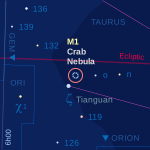
The faint Crab Nebula is near Taurus' southern horn-star, Tianguan, in the sky. This map shows the nebula artificially bright - at magnitude +8.4, it is in fact invisible to the naked eye.
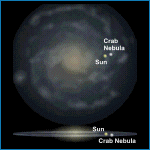
The famous Crab Nebula is some 6,300 light years from Earth. It falls within the boundaries of Taurus, lying in the direction of our Galaxy's rim.



 Show on Sky Map